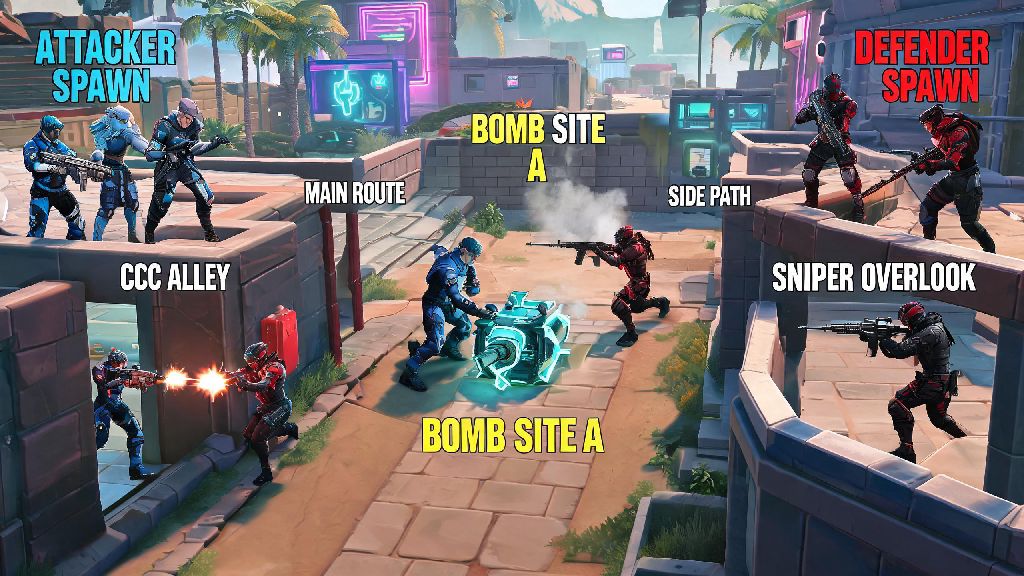
If you’ve spent any amount of time queuing for Valorant matches, you’ve probably jumped into a map you’ve never seen before and wondered why you never noticed it in prior queues. Riot Games regularly adjusts the game’s map pool to keep the meta fresh, support new game modes, and give long-time players new challenges to tackle. If you’ve ever asked how many Valorant maps are there across all official game modes, this guide breaks down every category, rotation rule, and pro tip you need to know to play smarter.
How Many Valorant Maps Are There in Total?
As of the latest game update, there are 14 total official Valorant maps released to the public, split across four different accessibility categories. That number doesn’t count test maps only available in dev servers or scrapped concepts that never made it to live play, so you won’t run into any of those in standard queues. 7 of these maps are currently in the active competitive ranked pool, while the rest are available in casual modes, limited-time events, or custom lobbies only.
It’s easy to get confused about the total count because Riot removes maps from the competitive pool every act to prevent the meta from getting stale. Just because a map isn’t in ranked queues doesn’t mean it’s gone forever, though. Most maps that get rotated out of competitive stay in unrated and casual queues, so you can still practice them for when they come back to the ranked pool later.
I’ve seen a lot of new players assume that only the maps available in ranked count as “real” Valorant maps, but that’s not the case. Limited-time maps for modes like Team Deathmatch or Swiftplay are fully designed, balanced, and part of the official map roster, even if they’re only available for a few weeks at a time.
Breakdown of All Current Valorant Map Types
Not all Valorant maps work the same way, and understanding the different categories will help you know what to expect when you queue up for different modes. Each category has specific rules for availability, and some are only accessible during certain events or act rotations:
For example, the map Bind was removed from the competitive pool in 2023 for a small rework, then added back six months later with adjusted site layouts and new angles to balance out the meta. If you only played ranked during that window, you might have thought Bind was gone entirely, but it was still available in unrated and custom lobbies the whole time.
That means you don’t have to panic if your favorite map gets rotated out of ranked. You can still play it in casual queues, and it will almost certainly come back to the competitive pool at some point in the future.
Key Things to Know About Valorant Map Rotations
Riot’s map rotation system might feel random at first, but there’s a clear structure to how they adjust the competitive pool every act. First, they almost always remove one map and add one new or reworked map per act, so the total competitive pool stays at 7 maps at all times. This keeps the meta from getting too stagnant, but also means you don’t have to re-learn a dozen new maps every few months.
The map rotation schedule is usually announced a few weeks before a new act launches, so you’ll have plenty of time to practice the new map before it hits ranked queues. I always recommend spending a few hours in unrated or Team Deathmatch on the new map before you queue for ranked, because most players will be unfamiliar with it, and you can get a big edge by knowing the basic angles and callouts early.
One common mistake I see players make is ignoring maps that are rotated out of competitive. Riot almost always brings old maps back eventually, so if you take the time to learn all the core maps, you’ll be prepared whenever they rejoin the ranked pool. It’s also helpful to practice old maps if you play a lot of unrated with friends, since they’re still available in those queues.
There are pros and cons to the rotation system, of course. The biggest upside is that the meta never gets boring, and you don’t have to play the same map three times in a row every time you queue for ranked. The biggest downside is that if you main an agent that’s especially strong on a map that gets rotated out, you’ll have to adjust your playstyle for the current pool. That’s part of the fun of Valorant, though, and it keeps the game challenging even for long-time players.
Tips for Learning Valorant Maps Faster
Learning all the Valorant maps might feel overwhelming at first, especially if you’re a new player, but you don’t have to memorize every single callout in one day. These tips will help you learn maps faster and feel more confident in queues, no matter your skill level:
First, use Team Deathmatch and Swiftplay lobbies to practice new maps. You don’t have to worry about planting the spike or winning the round, so you can run around the map freely and learn the layout without pressure. I usually spend 2-3 TDM matches on a new map before I even try it in unrated, just to get a feel for where the sites are and how to move between them.
Second, learn standard callouts instead of making up your own. Most communities use the same callouts for major areas of each map, so learning those will make it way easier to communicate with your team. You can find callout maps online, or just listen to what your teammates call areas during matches and repeat what they use. It’s much simpler than trying to make up your own names for every corner.
Third, spend 10 minutes before your play session running through common angles on one map. You don’t have to do this for every map every day, but focusing on one map per week will help you memorize the best peeking spots, defensive positions, and rotation paths faster. I used to do this every day before I queued for ranked, and it cut my site entry death rate by almost 30% in a month.
Finally, don’t stress about memorizing every single tiny corner of a map. You’ll pick up small details the more you play, and you don’t need to know every hidden angle to be a good player. Focus on learning the main areas first, then add smaller details as you get more comfortable.
Now that you know how many Valorant maps are there across all game modes, you can adjust your practice routine to fit your playstyle and goals. If you’re focused on your ranked climb, stick to learning the 7 current competitive maps and keep an eye out for rotation announcements each act. If you’re a casual player, feel free to mess around with all the casual and event maps, since they’re a great way to have fun without pressure. No matter how you play, taking the time to learn even the basics of each map will make your matches more fun and help you win more often.