If you’re a new player curious about whether Valorant is a good fit for you, or a parent vetting games before your kid downloads them, you’ve likely searched what is Valorant rated. It’s easy to assume all team shooters get the same generic mature rating, but Valorant’s age restrictions are actually tied to specific in-game content and regional rating board standards, not just its genre. This guide breaks down everything you need to know about the game’s official ratings, what content drives those classifications, and important caveats most official rating descriptions leave out.
What is Valorant Rated Across Major Global Regions?
Ratings vary slightly from country to country, as each board uses its own criteria to evaluate content. In the United States, the ESRB gives Valorant a T for Teen rating, meaning it’s recommended for players 13 and older. ESRB’s official notes cite fantasy violence, mild language, suggestive themes, and optional in-game purchases as the core reasons for the rating. ESRB’s T for Teen rating only applies to base game content, not unmoderated voice or text chat from other players, a detail many people miss when reviewing the classification.
If you’ve looked up what is Valorant rated for players in the EU, you’ve probably noticed it’s higher than the US rating. PEGI, the European rating board, gives Valorant a 16+ rating, citing moderate sustained violence, mild bad language, and online interactivity risks as the key reasons for the stricter classification. Other regional ratings include a MA 15+ rating from Australia’s ACB, a 15+ rating from South Korea’s GRAC, and a 16+ rating for players in mainland China.
That difference between ESRB and PEGI ratings doesn’t mean the game has different content in different regions. It just means each board weighs risks differently, with PEGI putting more emphasis on the potential for toxic interactions in open online play, while ESRB focuses almost exclusively on content created directly by the game’s developer, Riot Games.
Core In-Game Content That Drives Valorant’s Rating
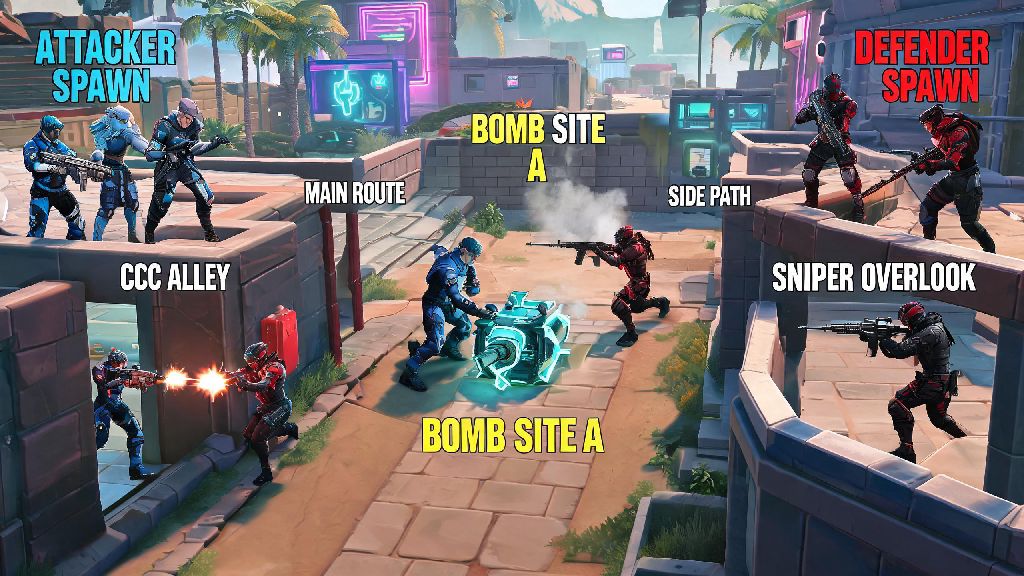
Many people who ask what is Valorant rated are surprised to learn how intentional Riot was about keeping the game’s core content accessible for teens, while still sticking to the competitive shooter format. The biggest driver of the rating is the game’s core gunplay loop. Every round sees two teams of five agents fighting to complete objectives, with takedowns involving guns, fictional abilities, and stylized blood splatters that disappear within a second of a player being eliminated. Unlike many mature shooters, Valorant’s violence is intentionally stylized to avoid graphic gore, with no dead bodies left on the map after a round ends and no dismemberment or realistic injury depictions at all.
Mild language is another factor in the rating. A small number of agent voice lines include mild swearing like “damn” or “hell”, though there are no explicit slurs or heavy swearing in any official Riot-created content. Suggestive themes are extremely limited, mostly amounting to form-fitting character skins and occasional teasing voice lines from agents like Reyna or Yoru, with no nudity or explicit romantic references anywhere in the base game.
Optional in-game purchases are the final core content factor cited by most rating boards. Valorant sells cosmetic skins for guns and agents, battle passes, and premium collectible bundles, with prices ranging from $5 for individual skins up to $100 for limited-edition premium packs. All real-money purchases in Valorant are for cosmetic items only, with no pay-to-win advantages, so spending money never makes a player more likely to win a match.
Important Caveats for Parents and New Players
Official ratings only tell you part of the story when it comes to how appropriate Valorant is for you or your family. The biggest gaps in official ratings relate to user-generated content and competitive play risks, which most boards don’t factor into their core classifications. If you’re evaluating whether to play or let your kid play, keep these key points in mind:
- Unmoderated cross-play chat: Default settings let you text and voice chat with all teammates, including random players you match with online. While Riot has automated chat moderation, it doesn’t catch every offensive comment, and players may use slurs, harass others, or make inappropriate remarks in unmoderated spaces. You can turn off all text and voice chat in settings in less than a minute if you want to avoid this entirely.
- Competitive toxicity risks: Ranked play can get extremely heated, as players work to climb the ranked ladder and earn higher ranks. Even with chat disabled, some toxic players will spam pings, emojis, or team kill to harass teammates they think are underperforming. You can avoid most of this by sticking to unrated casual play or only queuing with friends you trust.
- Spending risks: Valorant’s skins are designed to be collectible, with limited-time bundles and rotating shop selections that encourage impulse purchases. Younger players may accidentally or intentionally spend large amounts of money if they have a payment method linked to their Riot account without restrictions. You can set up parental controls to limit or disable purchases entirely through your Riot account settings.
I’ve played Valorant regularly for over three years, and I’ve seen both the best and worst sides of its player base. I let my 13-year-old nephew play the game, but only with chat disabled, purchases turned off, and his account set to only let him queue with friends he knows from school. He’s never run into a negative experience with those settings enabled, and he enjoys playing the game with his friends every weekend. You don’t have to write off the game entirely if you’re worried about toxic interactions or overspending, as almost all high-risk features are fully adjustable.
Common Misconceptions About Valorant’s Rating
There are a lot of wrong assumptions floating around about Valorant’s rating, mostly from people who haven’t played the game or haven’t looked into how rating boards classify content. One of the most common myths is that the game’s cartoony art style means it’s appropriate for kids of all ages. Even with stylized violence, the core loop of the game revolves around gunplay and takedowns, which is why every major rating board sets the minimum age at 13 or older. It’s not designed for young kids, even if the art style looks like it’s made for a younger audience.
Another common myth is that the PEGI 16 rating means there’s more explicit content in European versions of the game. That’s not true at all — the game’s content is identical across all regions, the only difference is how each board weighs risk factors. PEGI has stricter guidelines for online interactivity, so they mark most competitive team shooters with open chat as 16+, even if their base content is the same as a game that gets a T rating from the ESRB.
A lot of people also assume that playing casual unrated mode or custom games means the rating doesn’t apply. No Valorant game mode alters the core content that drives its official age rating. Even the game’s tutorial includes gunplay and takedowns, so the core content is present no matter what mode you play. The only way to adjust the content you see is to change your in-game settings, not to pick a different game mode.
One last myth worth debunking is that Riot can change the game’s rating at any time with patches. Any major content update that adds new mature content has to be submitted to all regional rating boards for re-evaluation, so the official rating will only change if there’s a major shift in the game’s core content, which Riot has said it has no plans to do.
At the end of the day, what is Valorant rated will vary slightly depending on where you live, but all rating boards agree it’s best suited for teens and older players. If you’re a new player or a parent evaluating if the game is a good fit, take 10 minutes to go through the in-game settings and Riot account controls to adjust features to match your comfort level. You don’t have to deal with toxic chat or unregulated spending if you don’t want to, and turning those features off doesn’t take away from the core strategic fun that makes Valorant one of the most popular team shooters in the world right now.